
By Jacqueline Chilton
Glenbrook has observed that as businesses develop increasingly sophisticated payment capabilities, they often need to revisit their organizational structure. Due to the importance of payments, fraud and exception processing to the bottom-line, many eCommerce merchants are establishing payment-specific centers of excellence within their finance, treasury or operations groups. The need for a dedicated payments function is driven by the complexity of the outside environment as well as conflicting priorities internally as sales teams seek to expand revenue and risk management works to minimize fraud.
Glenbrook Partners recently conducted research to assess the state of organizational development for eCommerce payments functions. Overall 9% of companies have neither a payments strategy nor a leader for payments decisions. At the other end of the spectrum we found that 15% of companies have a clear “Head of Payments” responsible for a payments roadmap and strategy. The remaining respondents fall somewhere in between.
There are myriad new eCommerce payment options and decisions to make concerning social payments, virtual currencies, bill-to-mobile, offer-based payments, alternative payments and foreign domestic payment types. The scope of payment acceptance decisions and new technologies drive complexity for eCommerce merchants. A dedicated payments group can support the over all business by keeping a handle on the impact various technologies have on payments behavior.
Approximately a third of the companies have a “payments gatekeeper” that responds to the sales organization as it requests new payment types. Survey responses broadly reflect conflicting motives within organizations when it comes to payments. One representative company characterizes its internal payments decision-making dynamic as “marketing asking for PayPal and IT saying no”.
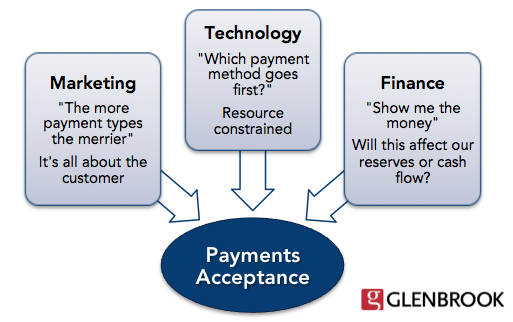
Implementing Best Practices
Historically payment acceptance decisions have been managed based on cost per transaction. Best in class organizations also look to drive incremental revenue from payments decisions and measure to see if they achieve anticipated results as a result of introducing new payment types. The payments organization takes an objective look at new payments types and can also retire payments options that do not deliver incremental customers.
Survey respondents that self-identify as “mature” or “sophisticated” payments organizations report several benefits associated with having organized around payments:
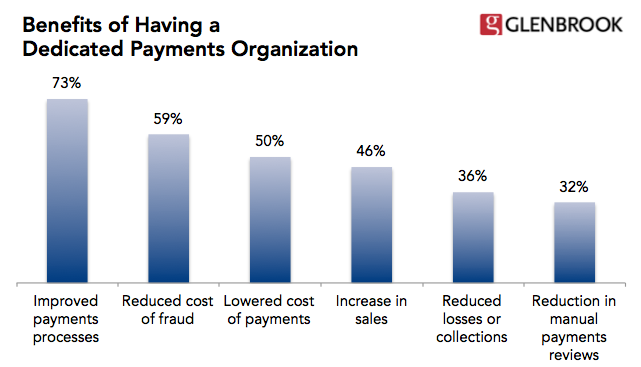
Almost a third of companies that responded to our survey reported that they had no payments organization or a nascent payments organization where payments are “less than 50% of anyone’s responsibilities”. These companies are missing out on the benefits.
Glenbrook Partners research on payments organizations is on-going. Best practices identified to date include having a head of payments and a clearly defined, separate payments organization. Sophisticated payments organizations involve finance and risk in payments decisions and engage in loyalty and customer experience conversations. New payments organizations often begin their journey by improving their internal payment decision-making processes, reducing exceptions (declines, chargebacks and fraud) and managing the cost per transaction. Mature organizations also measure the incremental sales that are achieved from payments acceptance.
If you would like to participate in our survey, please follow this link.
Editors Note: This article was originally published in the Direct Response Forum newsletter.
The Glenbrook team is comprised of talented professionals from all areas of the payments industry, including business management, marketing, technology, operations, risk management, and business analysis. They have held senior roles at central banks, international banks, card networks, merchants, fintech startups, payments processors, and more. Together, Glenbrook Partners has become known as the go-to source for problem-solving, insights, and learning. Our team of bright minds and critical thinkers is what makes it possible.
Through our education wing, we have educated over 35,000 payments professionals on topics ranging from B2B payments to digital currencies and policy and regulation. Our experienced consultants have helped organizations in 62 countries achieve their goals with strategy advisory, in-depth research, and more. In addition to supporting payment professionals, the Glenbrook team is a valuable resource on the top issues of the day, sharing their experience and insights with professionals eager to understand industry fundamentals and how they are evolving.