
It’s an auspicious year and month for us at Glenbrook as on March 1, 2026 we mark the 25th anniversary of the founding of our firm, celebrating a quarter-century of pushing forward the frontiers of payments knowledge and strategy and our continuing efforts to build the broader global payments community.
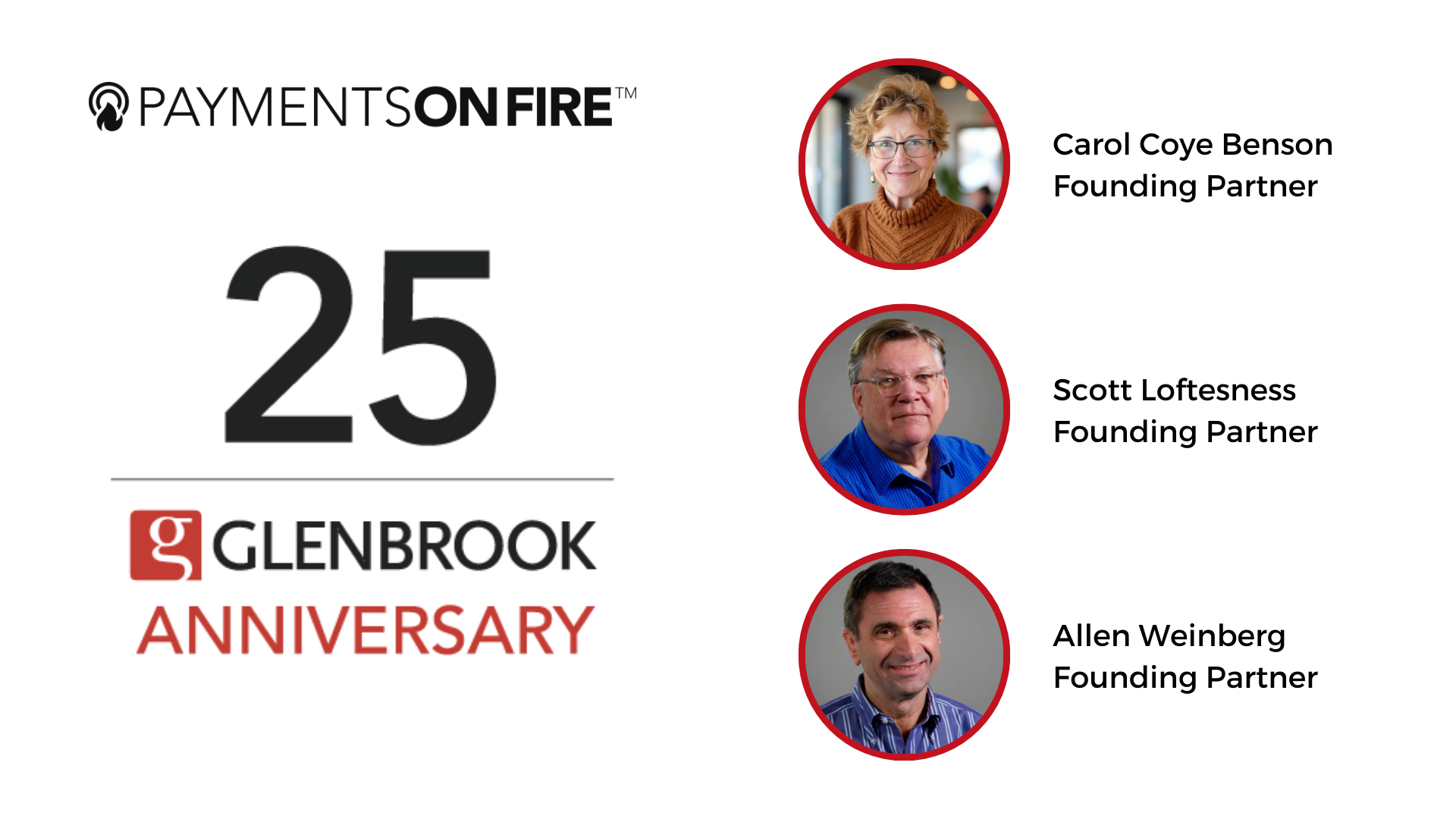
A lot has happened in payments over the last 25 years and there could be no better way to celebrate the progress of the industry and the firm than to talk to the people who played such seminal roles in shaping both: In this episode, Bryan Derman and Russ Jones speak with Glenbrook’s three founding partners – Carol Coye Benson, Scott Loftesness, and Allen Weinberg.
Listen in as they recall the early days of the firm, discuss how Glenbrook’s strategy work expanded to form our education and global practices, consider the evolution of the “payments professional”, and reflect on payments industry shifts over their years both in and out of Glenbrook.
Full Transcript:
Bryan Derman: Hi everyone. I’m Bryan Derman, Managing Partner at Glenbrook and your host for this episode of Payments on Fire. We’re back with one of our Fanning the Flames editions, where we speak with our own Glenbrook insiders about topics in the payments industry. It’s an auspicious year and month for us here at Glenbrook, as on March 1st, 2026, we marked the 25th anniversary of the founding of our firm, celebrating a quarter century of pushing forward the frontiers of payments, knowledge, and strategy, and continuing our efforts to build the payments community around the world.
For me, it was sometime in the middle of the year 2001 when a friend and industry contact by the name of Allen called me to say he was working with a couple of partners on starting a consulting firm that would be dedicated to the payment space. I was fully engaged at the time in a startup venture, but I took note of this development and promised I would keep in touch and watch the firm’s development closely.
While it would be another three years before I formally joined the firm, I enjoyed watching it thrive and grow as payments became a more fully recognized industry, gaining momentum as a source of innovation in the financial services industry. Well, payments continued to grow and evolve, eventually becoming the driving force in a movement that later became known as FinTech. That’s a phrase no one was using in 2001.
I could go on and on about the things that have happened in payments in these ensuing 25 years, but I wanted to do that with a special panel of people today, people who’ve played such seminal roles in making those things happen. Today, it’s my absolute delight to welcome to the pod Glenbrook’s three founding partners, Carol Coye Benson, Scott Loftesness, and Allen Weinberg.
Partners, a very warm welcome to Payments on Fire.
Scott Loftesness: Hey Bryan. Thank you.
Bryan Derman: So great to see all of you and to have the band back together.
Carol Coye Benson: Great to be here.
Bryan Derman: Yeah. Great to have you. So let me do a little bit of quick scene setting before we dive into some of the history of Glenbrook and some of what you’re seeing in the years since. As you guys know, we date the founding of the firm to March 1st, 2001. So we’re right up on 25 years. That’s a long time ago, and even longer in tech years.
And as I was thinking back on that time, I said, wow, we were just coming out of the internet bubble, the original tech wreck. It happened about a year before that. And it took down companies with some pretty suspect business models, but eventually took away about 75% of the value of the Nasdaq, and I didn’t know if we would ever make it back from there.
I remember back in those days, we were all using Windows computers. The hot mobile phone at the time was a little flip phone called the Motorola StarTAC. Although the truly cool kids like Scott were already using a thing called a Blackberry, even though back then it looked like a pager.
Scott Loftesness: No, Russ had a palm pilot. I think that was the cool kid thing.
Bryan Derman: Some people had started using a new online service called Google, but the main search engine in use in those days was still Yahoo.
A few emerging payments innovations were in place, like PayPal was around, though it had not yet gone public. But Visa and Mastercard were still these funny bank owned consortiums, claiming to be non-profit associations owned by their member banks. How that has changed. And of course, this is March of 2001, so 9/11 has not even occurred yet. So much of life has changed since those days.
So, Carol, I’ll start with you. Coming out of that environment 25 years ago, what were the circumstances behind Glenbrook’s first project? I think you brought the first client to what became Glenbrook.
Carol Coye Benson: Right. Well, the first project was a company called Neustar. I had been doing some solo consulting, some identity work for them, and in 2000 they were selected by ICANN, they were in the telecom domain, to be the domain registrar for the .biz domain. This was the first breakout from the .com .edu, et cetera domains. And they were very excited about it, but didn’t really know what to do with it.
And they asked me to bid on a strategy project, and that was too big for me alone. So I reached out to Scott for help and he suggested we include Allen, who I knew as well. And during the interview session with the CEO, I remember Scott dazzled the CEO by doing a live web search projected on the screen related to topics we were discussing as we went along. At the time, that was completely bleeding edge, it was just an amazing thing to do.
Bryan Derman: Scott has always been the wizard even on dial up.
Carol Coye Benson: I know, it was, it was dial up modem. I believe we beat out Accenture for the project. And we had tons of fun doing the project, so we decided why not just build a company and work together. The rest was history.
Scott Loftesness: Carol, one of the things, so we were in DC for, I don’t know, a week or something.
Carol Coye Benson: Three weeks, yeah.
Scott Loftesness: Three weeks. And Bryan mentioned this was before 9/11, and it turned out Allen had a relative-
Allen Weinberg: Yeah, it was my brother-in-law at the time.
Scott Loftesness: -who worked for ABC News, as I remember, at the White House.
Carol Coye Benson: Yep.
Allen Weinberg: Yeah.
Scott Loftesness: So, in fact, I was going to try and dig up the photos. There’s actually pictures of the three of us in the press room at the White House. And I remember going down the hallway towards the Oval Office and then sort of being told that I shouldn’t lean in or whatever. But those were the days.
Carol Coye Benson: Yeah.
Scott Loftesness: April, I think it was April of 2001. Yeah.
Allen Weinberg: We were standing at the podium, the press podium.
Scott Loftesness: A big White House sign behind it.
Allen Weinberg: Yeah. Yeah. Very cool.
Russ Jones: So apparently anybody can stand behind this podium, is that what you’re saying?
Carol Coye Benson: They could in those days. Yeah.
Bryan Derman: So Scott, I think back in those early days, one of the ways that a lot of people first got to know us was from the daily email you started, which came to be known as Payments News, a website we still maintain and a daily email now goes out in the evening to still thousands of subscribers.
And I always remember you coming to us one day saying, there’s this new publishing technology out there called the blog. And we all said like, what the heck is that?
Allen Weinberg: Can you spell it please? Yeah.
Scott Loftesness: I’m a morning person. I always used to wake up and grab the computer next to my bed. I guess I must have had a Power Book or something back in those days. Anyway, and I would scan Business Newswire and look for press releases. I think that originally started kind of a private email group.
Bryan Derman: I remember it being an old Yahoo Group.
Scott Loftesness: That’s right. Yeah. Yahoo had a group.
Bryan Derman: Even before my time at Glenbrook, I some sort of an email from you, or an invite to that group.
Scott Loftesness: And back in those days, you could, more often than not, get a domain name. And so I remember thinking, well, maybe we should just turn this into a newsletter kind of thing. And so PaymentsNews.com was available and got the domain and then just kind of one thing led to another and it went on from there.
I was just looking at my personal blog, which also started in 2001. So the, those things all kind of sprung from that same timeframe.
Bryan Derman: I remember you and I were kicking around on that one night on AIM, I think, as we would chat on in those days. And we said, okay, we’ve got Payments News, what else should we have? We sort of came up with Payments Views and 30 seconds later you had bought that domain and eventually moved into Payments on Fire.
Russ Jones: That tradition carries on till today. Couple weeks ago, I was renewing some domains. We have a lot of payment related domains, mainly from Scott’s work 25 years ago. And I saw that I could grab glenbrook.ai. I couldn’t help myself and man, did I think about Scott. I said Scott would grab this domain.
Scott Loftesness: Absolutely.
Bryan Derman: $35 well spent. Right. probably being registered through Neustar as we speak.
Scott Loftesness: There’s a funny story about dot AI, right? What is it? Netherlands Antilles or something? It’s some tiny country that owns the dot AI and they’re making a fortune on registering dot AI.
Bryan Derman: Amazing. Good stuff that keeps going on. Still a lot of readers.
Russ Jones: I think back to those, how Glenbrook has transformed over those years. When the three of you started the firm, you had no idea we’d ever be in the education business, right? It was all going to be strategy consulting for clients who had hard problems to solve. And you sort of observed very early on that clients needed a lot of fundamental understanding of the industry they were in. How did that at all evolve?
Allen Weinberg: I think we can sum it up. The phone rang.
Carol Coye Benson: As I remember, Scott had done a deck on the card industry for a client who was new to the business and it was pretty substantial, and we were debating how we could use it for other purposes more, more generally. And one of our partners, now sadly gone from us, Dennis Moser, suggested that we could use it for an open education session.
And I jumped on it as an idea. I thought that was a great idea of his and we built on this and what we found was a deep hunger for an understanding of the industry. And interestingly, through the years, it wasn’t really from outsiders to the industry. It was from insiders of the industry who wanted a more comprehensive understanding of the industry.
And we learned to emphasize what I’ve always thought of as sort of the Holy Trinity of teaching the industry, which was to understand the technology, the rules, meaning both regulation and payment systems rules, and the motivations of the participants, both the users and the providers.
And we would just kind of go back and forth and the everything else, the economics, the products, everything else fell out of understanding those three things. And I think all of the partners, as we took turns teaching these courses, ended up loving teaching it because we would dig deeper down into the industry as year after year. We taught and we learned from our clients, from the people who came to the courses.
It was one of the great experiences of my career was the time I spent doing that. I really, really enjoyed it.
Scott Loftesness: I always think of it as the best thing we ever did.
Allen Weinberg: One of the, sort of the pre-boot camp and the most used slide was these poor people who worked for the merchants were trying to explain to the CFO why their merchant discounts were so high and what can we do about it. And you still see that same chart that we did 25 years ago of explaining the economics and the money flows and who can influence what. I mean, we were greatly aided by the fact that maybe it still is this archaic, byzantine set of business model and plumbing.
Russ Jones: And, you know, even, even to this day, people literally in the last month have told me how important those economic diagrams are to them. They go back to ’em all the time. Let’s touch base on it one, one more time.
Carol Coye Benson: Once I was teaching a session and it was a small session and there was a very nice older gentleman there. And when I got to that slide, I faltered a bit because I knew who he was. And I walked through the slide and then I looked at him and he nodded and smiled.
He was the CFO of Mastercard.
Scott Loftesness: One of the things I remember in the very early days of talking about this, was the idea of the payments professional.
Russ Jones: Yeah.
Scott Loftesness: Remember, we kind of conceptualized the fact that there are some number of people in the world called payments professionals. I didn’t think at the time we had any sense of how big that group was going to be.
We were kind of thinking, what’s the market for an education thing like this? And so we had this sort of, okay, payments professional, that’s our target. How do we get there? And I think with the time we thought there maybe was a few thousand people that might even-
Russ Jones: One of the approaches was we were looking at magazines that were read by payment professionals and we’re trying to kind of like advertisers or something, we were looking at what was the readership of this magazine, that magazine, that magazine. What was the overlap between them and put your thumb up in the air and come up with a magic number.
Allen Weinberg: But you know, to put the notion of payments professional in context, when we first started working with a multi-trillion dollar company, the payments function was halftime for one person. It was halftime for one of the treasury people. It is just insane to think about it, but that was very common. If you think about just how the number of payments professionals has grown exponentially over the years, it’s sort of staggering.
Russ Jones: It really is. And that’s, for me, one of the big changes in the payment industry over those 25 years is when Glenbrook started, things were small. You look at transaction volume, headcount, number of alternative providers doing something. Like if there were three companies that did the same thing, that segment was oversaturated.
Allen Weinberg: Everything except wallets. There were a million wallets.
Russ Jones: Yeah. And today, the numbers are just so off the charts. And what we used to think of as a big merchant 25 years ago is just kind of a run of the mill merchant today. And the really big merchants are the size of some small countries in terms of gross domestic product, you know?
Allen Weinberg: Yeah, no joke.
Russ Jones: They’re gigantic in size.
Bryan Derman: I might have a little bit of a New York view on it, but I remember the bootcamps were kind of spinning up and then in 2005 or 2006, Mastercard suddenly announced that they were going to do an IPO. A book went out on the street, an S-1 as they’re called, and we started to get calls from investors, very sophisticated people who clearly knew nothing about payments. You would get questions like, uh, gee, I like these numbers, but if we go into a recession, won’t Mastercard get killed by all the credit losses? They don’t have much of a balance sheet to handle the credit losses. I said, we got some charts. We’ve got some charts for you. You need to understand this a little better.
And I remember that was probably one of the early inflection points on the bootcamps that made people realize they didn’t really know what was going on.
Allen Weinberg: And also think about the number of investment opportunities that mushroomed, all the fintechs as we call them now, but the gazillions of payments related startups that venture community and then later private equity needed to get their heads around. They’re all trying to put bets down on that big roulette table, hoping to hit the next PayPal.
Bryan Derman: But you’re right about that, Allen. There wasn’t fintech when we started out. That came along a few years later. I don’t know what year would be the first citation of the word fintech.
Allen Weinberg: I think. I think you made it up, Bryan.
Russ Jones: You know, at Scott’s urging, when we were looking for office space, he wanted to be as close to Sandhill Road as we could get because the thinking in those days was a lot of innovation was going to come from startup companies. That was a fun time in the early days at Glenbrook because so many of those companies famously, as you guys would say, would come through our conference room just play their story against us and see what we thought about what their opportunity space.
Bryan Derman: Right. The venture capitalists would listen to the pitch, scratch their heads and say, go give this pitch to Scott, and if he likes it, we’ll talk again.
Allen Weinberg: Yeah. It’s pretty accurate.
Scott Loftesness: I became known as Dr. No, I think, in the industry.
Russ Jones: Yeah.
Bryan Derman: Exactly. So Carol, at some point, I can’t remember quite when, you had the idea of sort of packaging up the course more formally and you turned it into a book that I like to keep on my left shoulder these days. What was that process all about?
Carol Coye Benson: It seemed just like a natural extension, you know? And probably today it would’ve been a YouTube video rather than a book, but really it was just a way to get the word out to a greater set of people. And I think it’s been useful in that regard. And I gather there’s another, there’s a new edition coming out, is that right?
Russ Jones: There is a fourth edition coming out in the next couple months. And that book that you and Scott wrote, the first edition was really back in 2012 and it was a different payments industry then in the US. So for the fourth edition, we’ve really kind of gone back and taken a hard look at every chapter because so much has happened in the industry.
Scott had written the chapter on payments innovation, and I was going through that a couple months ago, refreshing it and extending it, and it was kind of like whimsical, like these examples. Now, people wouldn’t even think they’re innovative.
Carol Coye Benson: It looks quaint.
Russ Jones: At the time, they were revolutionary. It was a bold breakthrough idea. People now would say, really? That was a breakthrough idea? Because the industry’s a lot more sophisticated, I think.
Carol Coye Benson: It is wonderful to see how it has changed. I was in New York City, what, like three weeks ago when the big snowstorm hit, and I still find it just thrilling that I can just use my phone on the subway and I just tap and get in and I don’t have to worry about anything. And it just works like a dream.
And even though I wasn’t on the Glenbrook team that helped make that happen, I always have a little sense of pride that we played a little bit of a role in that.
Allen Weinberg: It’s funny ’cause I just have to roll my eyes now ’cause I’m at point of sale somewhere, right? And I’m trying to like tap my phone or tap my card and I have this teenage salesperson behind the counter explaining to me how it works. And I just want to go, well, my name’s on most of the patents here, but-
Carol Coye Benson: I know. I know.
Scott Loftesness: The book did some fun things. One of the things I’ll never forget is I was sitting in our office in Menlo Park one day, I don’t think Russ was there that day, and these two guys walked in and came into my office and said, we’re looking for Scott. And I said, well, you found him.
Turned out it was the Collison brothers. This was the early, early days of Stripe. It was the two brothers and one other guy in Palo Alto. And Patrick, he said, we just wanted to say thank you. And I said, what do you mean? He said, thank you for writing that book. And then it was like, okay, great. Then they were gone. It was just an amazing kind of experience.
Russ Jones: Whatever happened to them?
Scott Loftesness: Yeah, whatever. Yeah. They’re both billionaires now. They’ve done very well. But the other thing it did is it opened up a bunch of other interesting doors. The one I remember, the other experience that happened to me was the legal community.
One of the things that happened along the way in the world of payments was patent litigation particularly around things like prepaid cards and so forth. And I remember being contacted by a law firm and then going into a meeting. This was back east. And there were half a dozen lawyers in the meeting and they all had the book and the book all had sticky notes on various pages.
Are you going to be able to testify to the diagram on page 63, kind of thing. And so that kind of opened, that book, somehow you become more authoritative in some ways when you write a book. So, talk about a compliment to the bootcamp. It was a whole nother door that opened with the book.
Carol Coye Benson: I actually had somebody recognize me at a bar once as the author of the book.
Scott Loftesness: Well, that’s the other thing. Sometimes I’ll see pictures of people in an airplane and they’re sitting there reading reading the book.
Bryan Derman: Amazing stuff. Carol, you joked about that it would be a YouTube video today. Russ is somewhere in the midst of converting it into a 19 part miniseries of on demand video module.
Scott Loftesness: We have our own Ken Burns.
Bryan Derman: You’re more right about that than you know.
Allen Weinberg: Do I get to pick who plays me? Yeah.
Bryan Derman: This is not a biopic.
Russ Jones: And sort of the genesis of creating a video companion to all of the educational stuff is one of our clients in Oakland, payments company in Oakland, California. The guy who was in charge of like corporate wide education, he told me his vision was he wanted one of his software engineers to get on Bart in Daly City and pull up a seven minute video thing on how interchange worked and when he got off at the Oakland Bart Station and came into work, he’d know everything he needed to know about interchange. And I thought, okay, we’ve got some work to do here.
Bryan Derman: A short course.
Russ Jones: Yeah, the short course for sure.
Bryan Derman: All right. So, Allen, as you know, we’ve always viewed one of Glenbrook’s differentiators as taking the time and trouble to focus not just on the providers in the industry, but the end users. Whether that’s a consumer on the one hand, but particularly payments acceptors, merchants, billers, other sort of people who need to take payment, but particularly the merchant community and the concerns they have had over the years about the cost.
At some point you had the idea of sort of consolidating a set of relationships we had formed into a thing that we have come to call the Merchant Payments Roundtable, a group that we continue to sponsor right up to this day. The group will be meeting again in April of this year.
Tell us about how that idea came together, how you put together the first couple of meetings of that club?
Allen Weinberg: Well, I came to find out that a bunch of merchants were informally getting together in a hotel room, around a coffee table, in a suite somewhere at the beginning or end of like MRC or one of the other industry conferences, and how helpful it was to them. But they were a little frustrated on the, it just wasn’t structured. There was no continuity. Nothing really ever came about it.
And yeah, I just thought that it might be interesting and I really didn’t go into it with the expectation that we’re going to turn into a group that was so valuable. And when I say valuable, I don’t mean just to Glenbrook, but the merchants. I take some great bit of pride that we were able to round up literally like the best merchant payments people in the industry. I mean, just bar none from merchants that were really working for the best and most innovative companies.
And the idea exchanges, with a lawyer in the room of course, guiding it to make sure we didn’t organize boycotts and talk about pricing. But the value that these merchants got out of that in terms of exchanging ideas with, not only between themselves in terms of benchmarking that we did, and we did a lot of work on best practices that they all benefited from, but being able to take the, what Glenbrook was able to provide for them was sort of looking ahead of the curve and also interpreting what was going on.
I think when we talk about payments professionals, I suspect that a lot of the payments professionals at merchants felt sort of lonely and misunderstood. You know-
Bryan Derman: Part education and part therapy. Right.
Allen Weinberg: Well, they’re working in a corner somewhere and merchants just want to sell stuff, as we used to say, and all this, the expense and complexity around payments, to be able to be able to understand the motivations of the networks and the motivations of the issuers, and be able to help vet the technology providers that were all calling upon them and exchange ideas around it was just so valuable to them.
And it was just fabulous. And I think one of our competitive advantages in working across the value chain was that we really, really understood the merchant side of the business, we really understood the payment network side of the business. We really understood the technology because we worked across the value chain, but the merchant piece was just, it was just fabulous. I mean, it was really, like I said, the best people in the business that we were able to get around and ultimately was expanded globally.
And I have to admit, I still have nightmares every so often, you know?
Bryan Derman: Those decks were a little nerve wracking to put together. I remember that, I forgot who it was who mentioned to me recently. You know, we’ve had a number of people who circled through that group or didn’t circle through, stayed on that group even as they moved from one merchant organization to another.
Allen Weinberg: Don’t laugh. There was, I can name at least three people whose terms of employment, right? When they were about, I’m not making this up, they were going to accept a job offer with a new employer and part of it was, is that they were able to join and the company would fund participation in the roundtable. I mean, that’s unbelievable.
Bryan Derman: I ran into somebody who made that point to me not long ago. Great point of pride when you hear that. Or once in a while when you’re scrolling through LinkedIn and you find somebody has credentialized themselves by mentioning that they are a graduate of the Glenbrook Payments Boot Camp, you sort of swell with pride and say, wow, we built something that’s way bigger than what we knew we were doing. Really cool stuff.
So, Carol, one last area that I think we’ve become pretty well known for in the external environment is work that you pioneered on financial inclusion across the emerging markets and finding cost effective ways to drive electronic payment into some pretty low income corners of the globe.
That work is ongoing and has been emblazoned in what the Gates Foundation calls its Level One principles. But fill us in a little on how you got into that and how it became the big deal that it is today.
Carol Coye Benson: Sure. Well, as you said, Glenbrook has developed really a substantial body of work in financial inclusion, and I do want to take a moment to thank the Gates Foundation as a significant client in our work in this field. And it really started when they asked us, and Allen and I were the early people involved with this. They and other development organizations were focused at the time in Africa where there were a lot of mobile telephone operators who were operating closed payments networks and the Gates Foundation wanted to understand how interoperable payments networks worked and came to us so that they could understand that so that they could advocate for interoperable payments systems in these countries.
And we worked with them to build out what became known as the Level One project principles, which were the principles of how you would design a payment system that was interoperable and that would work for all of the people in the country. And it was really extremely interesting because we were able to take what we learned in the commercial domain, particularly from large payment systems such as Visa and Mastercard, which not incidentally were originally non-profits, but also the principles of how the checking system worked and the ACH system worked and things like that, and apply this knowledge to the purposes of financial inclusion.
So it was a fascinating thing for me. I learned a ton, traveled a lot. And the Gates Foundation Level One project was and is a very important globally in showing how principle led development can be successful. I’m very proud, for example, of the work we did in countries like Pakistan and Tanzania, where this set of global principles were adapted to the specific country needs.
And then, actually, in-country systems were built to satisfy local country needs, but to adhere to the general high level principles like low cost and including all players and things like that, and to advance financial inclusion and has done a pretty good job of that.
Allen Weinberg: How insanely cool Carol to be able to design new payment systems from scratch. If you think about the people listening to this, what an insane opportunity for payment geeks like us to be able to literally design brand new payment systems watch them take off. I mean, it’s incredible.
Carol Coye Benson: It was, it was, it is still fun to see them rolling out.
Bryan Derman: And like everything else we’ve been talking about here, the work continues to this day. And we all love everything about payments, but when you talk about elements of your work that are just so kind of personally rewarding to see the impact that overlaying these kind of payment systems into an underdeveloped economy, that the impact that can have is just so satisfying.
Carol Coye Benson: One of my favorite anecdotes is in some of these countries where government employee payment to teachers or to policemen or such not are being made that were previously made in cash, now being made into a telephone wallet or a bank account. It’s not uncommon to hear stories that these people suddenly feel like they had gotten a raise, because the middlemen who are handling the cash are no longer taking their cut. For somebody who has not been used to working in these systems, it’s a really good illustration of the effect these systems.
Bryan Derman: The whole notion of, how did you do a personal remittance to a friend or a relative who lived many miles away from you in a totally cash-based economy? It is just so transformational compared to handing an envelope of cash to a bus driver.
Carol Coye Benson: Right. I mean, it’s not without problems, but it is great work to be involved with.
Bryan Derman: Yeah. Wow, that’s a great walkthrough of some of the really seminal developments at Glenbrook. It must feel good to the three of you to see that they’re all really continuing. They’re evolving and changing, but they remain relevant to the work we do to today.
If we turn the lens from backward to forward a little bit, I’d love to get your perspectives on what some of the big changes were over the years, over your years at Glenbrook or even in the years since you’ve left with a little bit of perspective away from it. What has impressed you, what surprised you, that’s happened in these 25 years?
Allen Weinberg: Well, looking backwards, I think it was Scott, you and I, maybe with Bryan, we used to joke in the old days, we talked about the holy grails of payments. The big things. And one of the things on the list was anybody can be a merchant. Remember? And we helped make that happen through a lot of the clients we worked with.
And to see now, you know, can I Zelle you, can I Venmo you? And it’s just so natural every day to watch these person to person payments. And the fact that nobody carries cash, even for small stuff, the vending machines that. We had a very, very big part in cashless vending and I think it’s the not necessarily a meteor hitting the earth, but there’s gradual evolution to making electronic payments for everybody. It’s really remarkable, I think, to see that. And to have a teenager try and explain to me how contactless payments work. I still get a kick.
Bryan Derman: Scott, how about you? What stands out to you in the ensuing years?
Scott Loftesness: If I look back up, part of it is I came out of the Visa world and you mentioned the IPOs, the Mastercard IPO and then the Visa IPO that followed. And then of course PayPal coming later, or coming earlier in that sense. That whole, the industry just really kind of grew up, I think, once those public offerings were in place.
But you had a much higher degree of interest in the industry as you mentioned. Investors suddenly tuned into what the card networks did and how they worked. That was a big deal, fundamental business. And then on the technology side, as Allen referenced, the whole mobile influence. I remember when the iPhone was announced in 2007, and then a couple releases later, I think it was the iPhone four or something where Siri was introduced. I remember Carol asking me, what does Siri do? Can you get it to do anything? And I was kind of frustrated at the time that it didn’t really do much.
But now we think about that mobile platform and the evolution of authentication. Remember when Apple introduced the fingerprint and then, Face ID, and of course, as Allen mentioned, contactless and second nature now to be able to use this fundamental technology building blocks that have happened along the way.
And then there’s the whole other, probably the third rail of crypto, which kind of came out of nowhere in 2010. Well, not so much out of nowhere. There was digital cash initiative earlier, but you know, the fundamental paper around Bitcoin in 2010. And blockchain, that whole architecture of a distributed database certainly was another major shift over the years.
It’s funny, I remember when I left Visa, which was in ’94, we had just basically completed debit card rollouts. And I remember when I left thinking that, well, we’re basically done from a product standpoint, you know, there’s nothing left to do. We did the credit card. Now we got the debit cards. The debit card’s going really well and, yeah, mission complete. And mission accomplished, I guess was the aircraft carrier side.
Anyway, boy was I stupid with that comment. And in particular, the piece that stands out to me that came along relatively soon after that was the whole world of prepaid cards. And so that’s another whole genre of it. That some people saw it coming, a lot of people didn’t, but ended up being a big deal. So anyway, those are some highlights.
Bryan Derman: Yeah, for sure. Carol, what stands out to you?
Carol Coye Benson: It’s hard to go back in time and think about the different pieces. What at this point in time, what I see is really how much it is all coming together into the digital world, so that mobile isn’t really something separate anymore. You sort of look at all of this stuff converging into a part of the digital experience that we’re all having. And payments are part of it and crypto is part of it and it’s all sort of happening together.
And I know you’re going to have some questions about the future. But in a way maybe that’s what we mean when you say that payments are growing up. They’re just growing up and they’re becoming integrated into this digital world.
Bryan Derman: We don’t talk about it as much anymore, but the technology enablement that happened, we all have this sense that within this 25 year period, there’s been just a massive acceleration in the way payments operate, in the pace of innovation. And I think one of the explainers has to be the technology environment that they exist in, right?
And again, 2001. No real mobile data network that was capable of doing anything. The devices were not capable. The cloud really didn’t exist as a practical consideration in those days. So those kind of enablers of payment innovation where you can do amazing things without buying any computers these days, I think we forget how remarkable that is.
Carol Coye Benson: And I think that really started to happen sort of pre COVID. I mean, for people listening, I’m visiting in San Francisco this week and I happened to rent a car and I took the, train from SFO to the rental car center. And I remembered it was probably seven or eight years ago when I was doing the same thing.
And I had done a last minute reservation on my iPhone for a car and I was pulling into the rental car center and I saw a banner on an electronic sign saying, Carol Benson, your car is in slot 1, 2, 3, or something. And it was the first time I’d really sort of seen personally the power of APIs connecting to my phone and to the rental car company’s app, you know?
And I was blown away because at that time I’d never seen everything coming together like that, quite like that, and now that’s an everyday occurrence. You see stuff like that and it’s like, oh, of course. Yeah. Everything’s plugged together and payments are just a piece of it
Russ Jones: And as a result, everything is personalized.
Carol Coye Benson: Right? Personalized and no longer particularly private.
Allen Weinberg: Well, one of the other Holy Grails we had, and I’d be curious about Scott and Carol’s perspective on this is, I’ve been retired coming up on four years now, and when I retired from Glenbrook, I purposely, Scott used to call it, walked off the cliff. I unsubscribe to every industry newsletter and thing, and unless it’s in the New York Times or Wall Street Journal or mainstream media regarding payments, I really wouldn’t know about it except as a consumer of payments.
And we talk about anyone can be a merchant. One of the other things I believe on the list was payments are completely invisible. And my observation, having been four years cold turkey out of payment says, I don’t see a lot of change. When Bryan and I get together and when our wives aren’t there to hear us geeking out about payments, I ask him what’s going on, and it’s, I suspect a lot of it is just very behind the scenes infrastructure security related.
But I don’t know, I have not seen, other than a continuation of existing trends of things like person to person and I really haven’t seen anything change visibly in four years, but tell me, did I just miss it, or not paying attention.
Scott Loftesness: Well, the thing that comes to my mind was, along the way we used to talk about make the car go away. I think about the whole, the first time you took an Uber and you kind of just got out of the car, or Waymo now, in San Francisco or wherever, where the payment just is happening behind the scenes in a way that makes the card completely go away. So yeah, it’s fascinating.
Carol Coye Benson: Bryan, if it’s okay, we’ll just seamlessly transition into the future here. But when we look at what is happening, and maybe not so much in the United States, but in some other countries and United States as well. The two areas are stablecoin, which I am increasingly skeptical about, and the digital national currencies, which I am highly skeptical about.
But you look at China and a handful of other countries and there are countries that are pursuing these actively. And so, certainly Glenbrook, I’m sure you’re all over it. But have to be continuing to follow that.
Bryan Derman: You and I are going to have to have one of those famous, long, argumentative dinners because I’m increasingly bought in into stablecoins, but a little bit of a skeptic on Agentic AI, which is the other thing nobody can stop talking about.
Scott Loftesness: I am just the opposite. I am like Carol on stablecoins. I am so consumed by AI stuff and what’s happening. It’s just, it’s amazing.
Carol Coye Benson: No, I’m with Scott on that. I am overwhelmed with wonder and terror on AI.
Bryan Derman: As with most things in payments, there will be probably a place for each of them. Hard to predict where it’ll be, but that AI more generally is going to be everywhere. We’re already seeing it, and I think we’re probably seeing it in places where we don’t even know it’s happening.
Scott Loftesness: I told Carol at lunch yesterday or on Tuesday, that one of the projects I remember back in the Visa days was we did a bake off between a, this was to develop anti-fraud detection systems. These are now called, I think, advanced authorization have kind of built into that whole platform.
But we did a bake off between a statistical platform, in fact, the guy that did the insider trading system for the New York Stock Exchange was the guy that we used. And then the other, the competing approach was the neural net based approach, where this professor out of Stanford, it turned out. We had great hope for the neural net approach, but it turned out there just wasn’t enough compute in the 1980s to be able to do what needed to be done.
And that’s the magic of what you see happening these days with AI. You could see the germ, the seed crystals were there back in that timeframe. And certainly the whole, the payment systems for many, many, you could call it AI, I mean, the whole risk systems in, in all the card networks are very sophisticated system
Allen Weinberg: We called it machine learning. Scott, remember?
Scott Loftesness: Machine learning was the old vernacular, right.
Allen Weinberg: Yeah.
Bryan Derman: I guess the generative element is what’s so new now and the natural language processing
Russ Jones: The thing about artificial intelligence, I kind of go back and forth depending upon my mood. Like one day it’s amazing and it’s going to change the world. And the next day I’m thinking, this is just fast computers and software.
Scott Loftesness: You’re both right.
Russ Jones: Yeah. Yeah. The algorithm inside of Google Maps that shows you the shortest path, that’s probably the best example of, for a lot of people, of how computers can do your thinking for you. That algorithm goes back to 1956, the shortest path algorithm. It’s just a lot faster.
Carol Coye Benson: This is Glenbrook at its best because we can immediately start an argument here. But I would say that even you, even if you accept the, it’s just a very smart computer, you take, what’s his name, Dario Amodei’s argument that you have a nation of geniuses, you have a hundred million of those very smart computers all doing everything in a second, and then it’s really something. So anyhow, but we’ll have to have this dinner and have the argument about AI.
Bryan Derman: The only hard problem left is how to generate enough electricity to keep it all going right.
Carol Coye Benson: Oh, you just do it in space.
Bryan Derman: Yeah, apparently. That’s right.
Allen Weinberg: The polar bears are getting together and rebelling.
Bryan Derman: We’re going to have to wrap up here pretty soon, but I can’t resist asking the question that I pretty often ask each of you individually when I see you, because having been retired for a while now, I value the perspective you have on Glenbrook and think about us as a going concern.
So as you look back from your comfortable purchase at, the baby you launched 25 years ago, tell us what you like, and I think you have a lot to feel proud of that we’ve talked about here, but things that you like and then tell us what we could be doing better.
Scott Loftesness: Do I feel completely inadequate to comment on what you could be doing better, Bryan?
Allen Weinberg: Agree.
Scott Loftesness: Part of it is, to some extent, the approach that Allen took is a bit where I’ve also gone in the sense of kind of turning down the volume on that. So I’m not sure I could offer any great words of wisdom, just press on.
I mean, it’s such a wonderful industry and the footprint just keeps getting bigger and bigger and the technology impact is more and more significant. So I think you’ve got all the valves and all the knots to twist there and just keep doing.
Bryan Derman: We’re just hanging on and trying to keep up.
Carol Coye Benson: I’m just very proud to have contributed to the growth of this industry. It’s been the great honor of my career to be involved in that. But in terms of, it’s not a question of doing better, but if I would have a hope for what the partners would take on, in addition to everything that you’re doing now, is I think you need to be part of a dialogue on aI safety as it pertains to payments. I think that’s going to be a critical issue, in every domain.
And people need to be thinking, I mean, they are thinking in the tech world about AI safety. There’s huge debates going on, but it’s going to have its challenges in every corner of industry and, you guys should be thinking about it. I hope you are.
Bryan Derman: We’re taking notes. Allen, any final words of wisdom for us?
Allen Weinberg: Not in terms of stuff you should be doing better, I don’t have any visibility. But I think one of the things that made Glenbrook successful in the marketplace, when I say that, I mean value by our clients, was the, I can’t remember which of my fellow partners said this, but said good consultants always have an opinion.
And, I think it was Carol or Scott, I can’t remember Carol. I know you always have an opinion matter what, but you have several opinions usually.
Russ Jones: At the same time.
Allen Weinberg: Yeah, usually conflicting with each other. I think that was just one of the things that made it fun to work at Glenbrook.
And it was some of the value that we brought to our clients as we had opinions and we weren’t always right, but we were thinking, thinking straight, fact-based. And I think that’s what really needs to be, hopefully it’s still being preserved, you know?
Bryan Derman: I can’t go wrong doing that. Well guys, thank you so much. What a fascinating tour of the last 25 years and maybe a little preview into the next 25. Amazing how much has changed and yet, if anything, the pace seems to be accelerating. When you’re trying to figure out where things are going, it’s good to know where they’ve been.
So thank you so much for a thousand contributions over the years, only a few of which we really touched on today. As I always like to say, without you, no us. So thank you for that.
To all our friends out there in payments universe, thanks as always for joining us. Thanks for taking us along on your payments journey and giving all of us the fantastic career opportunities we’ve enjoyed and thanks for the chance to play some small role in the great things you are doing.
Until next time, keep up the great work. As Carol said, keep the world safe for payments.